CAPE COAST
Fort William, Cape Coast
The surviving hill fort overlooking Cape Coast, associated with the defensive and signalling system protecting the castle and British settlement.
Explore Fort William →Cape Coast Castle Museum · Cape Coast · Central Region · Ghana
The British power centre on the Gold Coast — and the gateway to a much larger history
Cape Coast Castle was never simply a castle. It was a trading post, slave-trading depot, military position, administrative headquarters, school, prison and symbol of British power on the Gold Coast. From here the British dealt with African merchants and rulers, competed with other European powers, governed their coastal possessions and confronted the expanding Ashanti Kingdom inland.
The castle is the centre of the story. But it is not the whole story. Around it stood a network of forts, trading positions and African communities whose history is inseparable from the building that survives today.
Cape Coast Castle began as a European trading fort. It became something much larger: one of the principal centres of British power on the Gold Coast.
The first permanent European structure on the site was established by the Swedish Africa Company in 1653 and was known as Carolusborg. The Swedes were part of a much larger European competition for access to the gold and other commodities of the West African coast.
Control changed hands during the intense rivalry of the seventeenth century. The British seized the fort in 1664–1665 and subsequently expanded it into the great castle whose surviving form dominates Cape Coast today.
The building therefore predates British colonial rule in the modern sense. It grew out of an earlier system of European-African commerce and rivalry, and its functions changed repeatedly as the balance of power on the coast changed.
The castle did not become important because it was large. It became large because the trade, politics and military competition around it became important.
European companies came to the coast primarily to obtain commodities including gold. Cape Coast was part of a commercial world in which African traders, states and European companies negotiated, competed and exchanged goods.
The castle became deeply involved in the transatlantic trade in enslaved Africans. Dungeons beneath the building became holding spaces before captives were transported across the Atlantic.
As British influence expanded, Cape Coast became a centre of administration as well as commerce. The castle served as the seat of British government on the Gold Coast before the colonial capital moved to Accra in 1877.
Today the building functions as a museum and memorial. Its meaning is no longer the meaning its builders intended: it is now one of Ghana's most powerful places for confronting the history of slavery, colonialism and the African Diaspora.
Start with the detailed history. Our main History of Cape Coast Castle page follows the building through its Swedish, Danish, British, commercial and colonial phases.
British possession of Cape Coast was never just about owning one fort. The castle gave the British a physical headquarters from which they could operate within a much wider coastal and inland system.
British merchants competed with the Dutch, Danes, Swedes and other European powers for commercial advantage. The result was a coastline crowded with fortified trading posts, each occupying a particular place in a network of commerce, diplomacy and military competition.
By the eighteenth and nineteenth centuries, Cape Coast had become deeply embedded in British political and commercial strategy. The castle was headquarters for British commercial administration and later became the seat of the colonial government.
The castle's real weapon was not its cannon. It was its position at the intersection of trade, information, military power and political authority.
The Swedish Africa Company establishes a fort on the site.
The British seize the fort during the European struggle for control of the Gold Coast.
The castle becomes increasingly important to British commercial and political interests.
Britain abolishes the transatlantic slave trade, although slavery and illegal trading do not simply disappear overnight.
Cape Coast becomes a major centre of British government and military activity.
The colonial administrative capital is transferred from Cape Coast to Accra.
The history of the castle therefore cannot be reduced to the slave trade. That trade was central and devastating, but the building subsequently became an administrative and educational centre as British colonialism developed.
Cape Coast faced the Atlantic. The power the British feared most was inland.
The Ashanti Kingdom, centred on Kumasi, became one of the most powerful states in the West African interior. Its political and military strength brought it into direct competition with European interests on the coast and with neighbouring African states.
The relationship between the British and the Ashanti was not a simple story of two sides permanently at war. It moved through periods of diplomacy, trade, negotiation, alliance, confrontation and open warfare.
Cape Coast mattered because it was one of the British coastal bases from which that changing relationship was managed.
British power was concentrated along the coast and increasingly backed by naval and imperial resources. Ashanti power was centred inland and rested on a sophisticated political system, military organisation and control over important trade routes.
The Fante states and communities along the coast were not passive spectators. They negotiated with Europeans, defended their own interests and sometimes sought British support against Ashanti pressure. Their political agency is essential to understanding the period.
Control of trade routes, markets, territory and political influence repeatedly brought British and Ashanti interests into conflict. Coastal forts were therefore commercial buildings and strategic positions at the same time.
The nineteenth century saw a series of Anglo-Ashanti wars. The final great confrontation came with the War of the Golden Stool in 1900–1901, when Ashanti resistance again challenged British authority.
To understand Cape Coast Castle, you have to look inland. The castle was coastal, but the political world around it extended all the way to Kumasi.
See also: The Kingdoms of Ghana , Major Ghanaian Kingdoms Involved in the Slave Trade , and Ashanti, Fante and the Trans-Atlantic Slave Trade .
The 1900–1901 conflict is remembered as the War of the Golden Stool, because the British demand for the sacred Golden Stool became the immediate symbol of a much deeper struggle over sovereignty.
The Golden Stool was not simply a throne or piece of royal furniture. It represented the spiritual and political unity of the Ashanti nation. A demand that it be surrendered was therefore understood as a demand touching the very basis of Ashanti authority.
Yaa Asantewaa, Queen Mother of Ejisu, emerged as one of the most famous leaders of the resistance. Her role has made the conflict one of the most enduring symbols of African resistance to British colonial rule.
The War of the Golden Stool should not be treated as an isolated episode. It was the final expression of decades of competition over political authority, territory, trade and sovereignty between the British and the Ashanti state.
The eventual British victory brought the Ashanti state firmly under British colonial control. The political consequences extended far beyond Cape Coast, reaching Kumasi and transforming the relationship between the coast and the interior.
Cape Coast Castle was the headquarters. It was never the only fortification.
The Cape Coast area contained a group of smaller military positions that supported, protected and extended the reach of the main castle. Some survive. One has disappeared. Others belong to the wider coastal network rather than to Cape Coast itself.
This distinction matters. A visitor can still climb the surviving hill forts of Cape Coast, but the historical landscape was larger than what survives physically today.
CAPE COAST
The surviving hill fort overlooking Cape Coast, associated with the defensive and signalling system protecting the castle and British settlement.
Explore Fort William →CAPE COAST
A smaller nineteenth-century British position on the western side of Cape Coast, built as a watch and signalling post with broad views over the coast.
Explore Fort Victoria →CAPE COAST · LOST
A vanished Cape Coast fortification. No visible remains survive, making it a useful reminder that the historic fort network is larger than the buildings visitors can still see.
Explore Fort Royal →WIDER COASTAL NETWORK
Komenda lies west of Cape Coast and represents the wider system of competing European trading forts along the Gold Coast rather than the immediate Cape Coast hill-fort group.
Explore Fort Komenda →Four names can be listed in a row. They should not be treated as four identical buildings. Each had a different history, location, purpose and fate.
For the broader picture, see our Map and Context of the Gold Coast and Full List of Forts and Castles in Ghana .
Not every important fort near Cape Coast belonged to the Cape Coast fort group. Anomabo was a major centre in its own right.
Fort William at Anomabo stood in the Fante town of Anomabo, east of Cape Coast. It belongs in the wider story of the Gold Coast's coastal fort system, but it should not be presented as one of Cape Coast's three surviving or vanished hill forts.
During the eighteenth century, Anomabo became one of the most important British trading positions on the coast and was deeply involved in the transatlantic trade in enslaved Africans.
Its history also demonstrates why European forts cannot be understood without the African towns around them. The British operated inside a Fante political and commercial landscape, negotiating, competing and sometimes fighting for access and influence.
Explore Anomabo separately. Fort William at Anomabo has its own dedicated heritage site: Fort Anomabo — Ghana-Net . Our background article is also available at Fort William at Anomabo: Ghana's Forgotten Slave Trade Powerhouse .
The castle's most painful history is also the one that connects Cape Coast directly to the wider history of the Americas and the African Diaspora.
Cape Coast Castle became a major British base in the transatlantic trade in enslaved Africans. Captives were brought into the castle, confined in its dungeons and eventually taken through the castle's coastal exit toward ships bound for the Americas.
The trade was not a process conducted by Europeans alone. European merchants depended on African political authorities, merchants, brokers, soldiers and transport networks. African societies were themselves divided by the trade: some profited from it, some participated under pressure, some resisted it, and many suffered from warfare and enslavement.
The castle is a European-built structure. The history that passed through it was African, European and Atlantic at the same time.
The surviving underground spaces are among the most powerful physical reminders of what happened here. They were places of confinement, not simply architectural features.
The castle's Atlantic-facing exit has become one of the most recognised symbols of the forced departure of Africans into the transatlantic world.
Captives did not originate at the castle. They came through regional networks involving warfare, political expansion, markets and long-distance trade routes.
The people transported from this coast became part of societies throughout the Americas and the Caribbean. Cape Coast therefore has a history that reaches far beyond Ghana.
Continue with Tracing the Slave Routes of Ghana and West Africa , Ghana, the Slave Trade and Historical Legacy , and The Last Shipment .
A castle can make history look European because stone walls are what remain. The people who made the surrounding economy work are much harder to see.
Cape Coast was a Fante town and a major African commercial environment before and during European colonial expansion. African merchants, chiefs, brokers, soldiers, artisans, interpreters and political authorities interacted with the Europeans who occupied the forts.
The Ashanti state, Denkyira and other Akan powers also shaped the flow of people and goods toward the coast. Their wars and political relationships affected the supply of captives, access to trade routes and the balance of power between coastal and inland states.
The history should therefore not be reduced to "Europeans built forts and Africans were taken away." The actual history involved African states and communities exercising power, making decisions, resisting, negotiating, profiting, suffering and adapting inside a rapidly changing Atlantic economy.
Read more: Inside the Slave Castles: The Untold Role of Local Ghanaians and Ashanti, Fante and the Trans-Atlantic Slave Trade .
Britain abolished its participation in the transatlantic slave trade in 1807. That did not turn Cape Coast Castle into an irrelevant building.
Instead, the castle entered another phase. British interests increasingly focused on commodities including gold and other legitimate trade, while the colonial state expanded its administrative and military reach.
Cape Coast became an important centre of education as well as government. The castle subsequently served several administrative and institutional functions before eventually becoming the heritage site visited today.
Abolition changed the purpose of the system. It did not erase the system that had already been built around it.
The nineteenth century therefore matters just as much as the eighteenth when trying to understand the castle. This was the period in which a commercial fortress increasingly became an instrument of British colonial administration.
Cape Coast Castle is part of the UNESCO World Heritage property Forts and Castles, Volta, Greater Accra, Central and Western Regions, inscribed in 1979.
The UNESCO property is not a single building. It encompasses a large group of fortified trading posts spread along approximately 500 kilometres of Ghana's coastline, representing centuries of European-African encounters and the development of both the gold trade and transatlantic slave trade.
The Cape Coast area is consequently best understood as one part of a coastal system rather than an isolated historic monument.
That system included Cape Coast Castle, Fort William, Fort Victoria and the lost Fort Royal, while other major positions such as Komenda and Anomabo formed part of the wider network.
UNESCO also identifies the condition of Ghana's forts and castles as vulnerable to environmental pressures, development pressure and inadequate funding for regular maintenance and conservation. Heritage status does not automatically solve the problem of preservation.
Cape Coast offers an unusual opportunity to see different outcomes of the same historical system within a very small geographical area.
Cape Coast Castle, Fort William and Fort Victoria remain visible physical structures.
Fort Komenda survives in partial ruins and belongs to the broader coastal fort system.
Fort Royal survives in historical records and maps but has no visible remains.
The contrast is important. The historical landscape is not identical to the tourist landscape. What visitors can photograph today is only the surviving fraction of a much larger network.
Our Fort Royal — The Fort That Isn't There page explores that disappearance in detail.
This is a place to visit slowly. The architecture is impressive. The history is heavier.
Cape Coast Castle is open to visitors and operates today as a museum and heritage site under the Ghana Museums and Monuments Board. A guided visit is strongly recommended because the significance of the rooms, dungeons, courtyards and passages is not always apparent from the architecture alone.
The castle can also be combined with the surviving hill forts and other historical sites around Cape Coast and the Central Region.
Allow enough time to understand the building itself before moving on to the other forts. The castle is the central reference point for the regional story.
Fort William and Fort Victoria offer a very different experience: smaller defensive structures and elevated views.
Fort Komenda puts Cape Coast into the wider coastal system of rival European trading positions.
Sites such as Assin Manso and the wider slave-route landscape connect the coastal buildings with the inland histories that fed and resisted the Atlantic system.
For a practical day covering multiple sites, see our Guided Tours of 6 Forts and Castles .
Cape Coast Castle makes most sense when it is placed back into the landscape around it.
We may earn a commission when you book a recommended tour, at no extra cost to you. No operator has paid to appear on this page.
Cape Coast Castle survived because successive powers continued to find a use for it. Swedish traders built the original fort. British merchants took it over. Slave traders used its dungeons. Colonial administrators governed from it. Teachers and students passed through it. And today visitors come to confront what happened inside its walls.
The Ashanti Kingdom survived for centuries as a powerful inland state before British conquest transformed the political map. The Fante communities of the coast negotiated their own position within the same changing world. European forts rose and fell around them. Some survive. Some are ruins. Some have disappeared completely.
Cape Coast Castle is not the history. It is the place from which you can begin to see the history.
From here the story runs inland to Kumasi, west to Komenda and Elmina, east toward Anomabo and beyond, and across the Atlantic to the communities formed by the forced migration of millions of Africans.
That is why this castle matters.
Research and editorial review: . Cape Coast Castle began as the Swedish Carolusborg in 1653 and was subsequently taken over and expanded by the British. It became a major British commercial, military and administrative centre on the Gold Coast and was deeply involved in the transatlantic trade in enslaved Africans. Cape Coast was the seat of British colonial government before the capital moved to Accra in 1877. The castle's history is inseparable from the history of Fante communities on the coast, the Ashanti Kingdom inland, European commercial rivalry, the Anglo-Ashanti wars and the development of British colonial rule. The Cape Coast area also contained a wider network of defensive and trading positions, including Fort William, Fort Victoria and the vanished Fort Royal. Fort Komenda and Fort William at Anomabo belong to the wider coastal network rather than being treated as identical components of the immediate Cape Coast group. The UNESCO World Heritage property covering Ghana's forts and castles was inscribed in 1979 and represents centuries of European-African encounters, gold commerce, the transatlantic slave trade and the history of the African Diaspora. Historical interpretation is continually refined as archival, archaeological and local evidence develops. Where individual dates, roles or locations remain disputed, this page does not present uncertainty as certainty. All photography © Remo Kurka. Usage strictly by prior authorisation only.
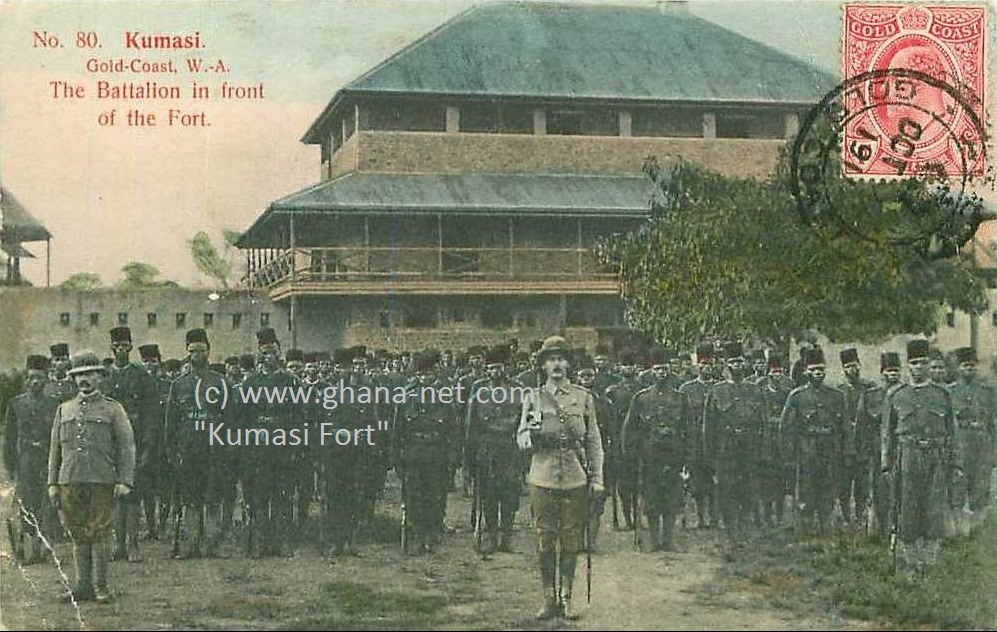
Kumasi Fort - Former Ashantene Palace
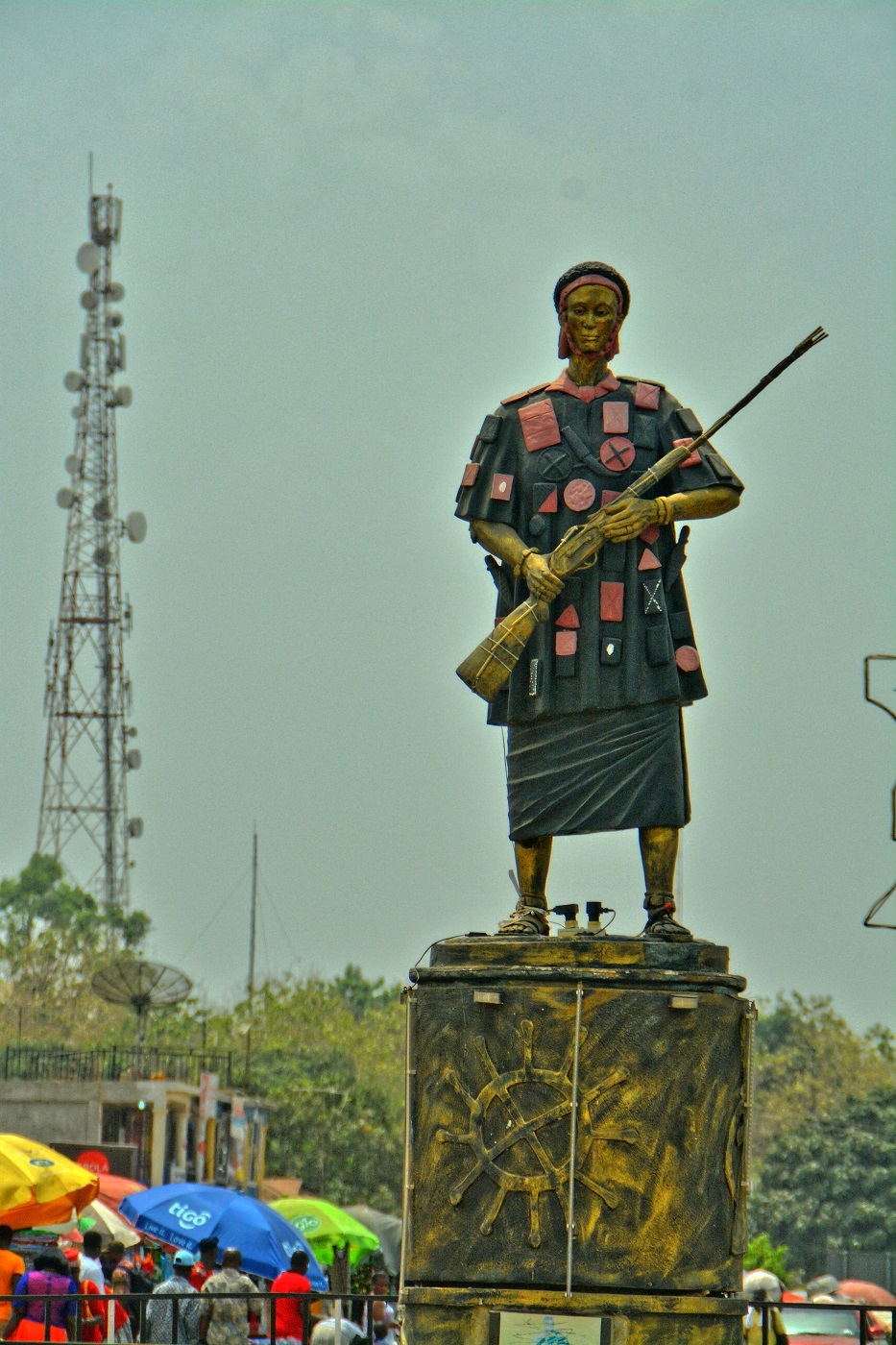
Kumasi statue memorial of Yaa Asantewa Queen Mother (c) Remo Kurka
Yaa Asantewaa – Warrior Queen Mother of the Ashanti
Yaa Asantewaa (c. 1840 – October 17, 1921) was the Queen Mother of Ejisu in the Ashanti Empire, located in present-day Ghana. She is best remembered for her courageous leadership during the War of the Golden Stool in 1900, a pivotal conflict against British colonial forces.
At a time when the British were seeking to further subjugate the Ashanti people and demanded the surrender of the Golden Stool—the sacred symbol of Ashanti sovereignty and spiritual identity—Yaa Asantewaa rose to prominence. When the Ashanti male chiefs hesitated to confront the British demand, Yaa Asantewaa famously challenged them with a powerful speech, saying:
"If you, the men of Ashanti, will not go forward, then we will. We, the women, will fight."
With these words, she assumed leadership of the Ashanti resistance, organizing and commanding a force of thousands. She became the first and only woman to lead an Ashanti army in war, directing strategies and defenses during the siege of the British fort in Kumasi.
Although the British eventually broke the resistance and captured Yaa Asantewaa, her leadership became a powerful symbol of anti-colonial resistance. She was exiled to the Seychelles, where she died in 1921. Her bravery and defiance remain celebrated across Ghana and beyond, symbolizing the strength of African women and the enduring spirit of resistance against colonial domination.
Today, Yaa Asantewaa is honored as a national heroine in Ghana, with monuments, schools, and festivals commemorating her legacy.