Cape Coast Castle Museum · Cape Coast · Central Region
Fort Victoria, Cape Coast
A Colonial-Era Outpost Above the Town
It was built in 1821 — the year the British Crown took the Gold Coast forts out of merchant hands, and two years before the first war with the Ashanti. It was called Phipps Tower after a company governor, then renamed for a queen. One small building, and the whole shift from trading company to empire is written into it.
1821 — the year it went up
Fort Victoria is a historic military structure in the western part of Cape Coast Township. It was constructed in 1821, on the site of an earlier fort.
That year matters more than most accounts allow. 1821 is when the African Company of Merchants was dissolved and its Gold Coast possessions passed to the British Crown. Cape Coast Castle stopped being a company asset and became government property.
Almost the first thing the new administration did was start building lookouts facing inland.
Two years later, in 1823, the first of the Anglo-Asante wars began. Whether the hill forts were built in anticipation of that or simply as routine consolidation, the sequence is on the record: Crown takeover, hill forts, war — inside four years.
It replaced something older. The page record notes an earlier fort on the same site. Hilltop positions of this kind were rarely chosen twice by accident — whoever put the first structure there had already worked out that this was the ground that mattered.
Phipps Tower, then Fort Victoria
It was first known as Phipps Tower, named in honour of Governor James Phipps, a British colonial administrator on the Gold Coast.
It was later renamed Fort Victoria, in tribute to Queen Victoria — reflecting the growing influence of the British Empire through the nineteenth century.
Named first for a man who ran a trading company. Renamed for a monarch who ruled an empire. The building did not change. The thing it belonged to did.
Small forts are usually treated as footnotes to the castles, but they carry this kind of evidence unusually clearly. A castle gets rebuilt so often that its layers blur. A watchtower keeps its name changes, and the names are a record of who thought they owned it.
What it was watching for
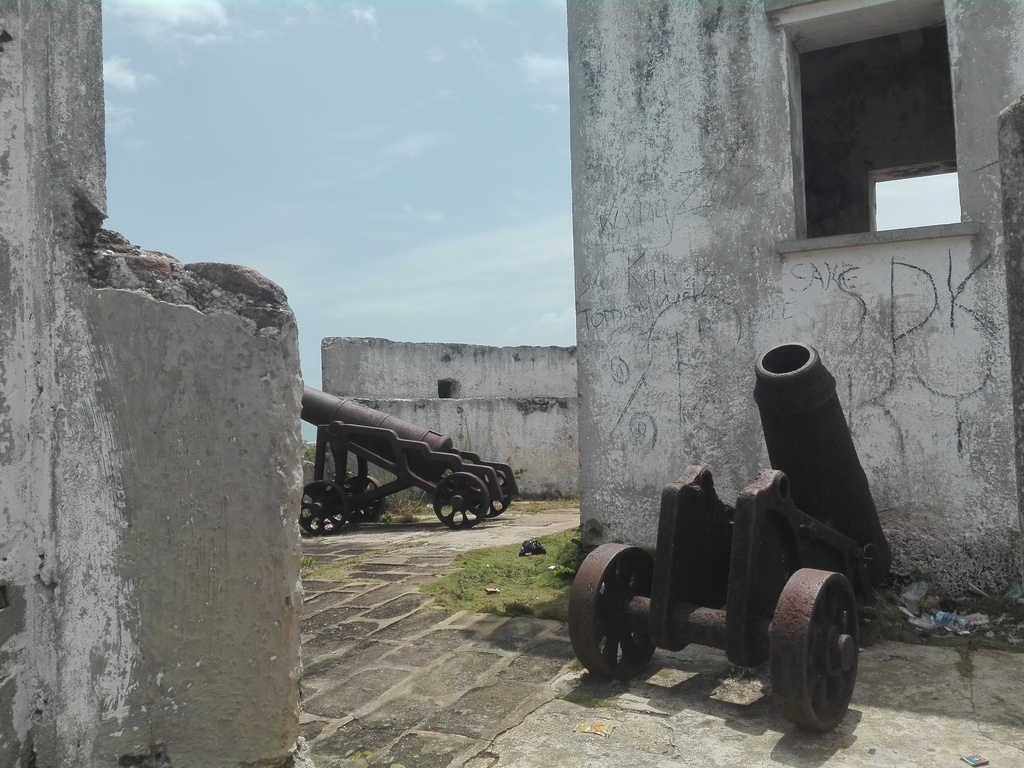
Fort Victoria was built as a watchtower and signalling post, offering wide visibility across the surrounding area, including the Atlantic.
Its primary purpose was to detect and fend off potential attacks — from rival European powers, from local resistance, or from pirate vessels — and to send signals between British installations along the coast.
Rival Europeans
The Dutch held Elmina a few kilometres west until 1872. Danish forts lay east. This coast changed hands repeatedly, and a fort that could see a strange sail early was worth a great deal.
Local resistance
The phrase covers a lot. The Fante on whose land these forts stood, and the Asante inland, were not passive neighbours — they were powers with their own armies and their own interests. See Ashanti, Fante and the Trans-Atlantic Slave Trade.
Pirates
Real, and a serious commercial risk. A slow merchantman waiting offshore for a cargo was an obvious target, and the forts' guns were as much about protecting shipping as about holding ground.
Signalling
The most useful function of all. Flags and lights from a hilltop carried further and faster than a rider, and a chain of them meant news travelled the coast in minutes rather than hours.
The ring of three
Fort Victoria worked in conjunction with the other posts around the town — most notably Fort William, with which it maintained direct visual contact because of their close proximity.
That is the key to understanding all three of these small forts. They were not independent curiosities. They were a system.
Cape Coast Castle faced the sea and its guns pointed outward. That left the town and the hills behind it — the direction any land attack would come from. The answer was a set of hilltop positions ringing the castle from inland, each watching a different approach and each within sight of the others.
- Fort William — on Dawson's Hill. Watchtower and lighthouse, 1819–20.
- Fort Victoria — western Cape Coast Township, 1821. This page.
- Fort Royal — the third, and the least visited of them all.
Walk all three and the logic is immediate. Stand on any one and you can see the other two, and the castle below. That is not scenery — it is the design, and it is still legible two hundred years later. No operator sells this as a route, which is exactly why we describe it.
UNESCO, 1979
Fort Victoria was part of a broader network of European-built forts and castles along the coast of West Africa. These structures played crucial roles in colonial trade, military defence and administration during the era of European expansion — particularly in the transatlantic slave trade.
In recognition of their historical significance and architectural legacy, Fort Victoria and its neighbouring forts and castles — including Cape Coast Castle and Elmina Castle — were inscribed on the UNESCO World Heritage List in 1979. The designation acknowledges this region's critical role in global history, especially in relation to European colonisation and the Atlantic slave trade.
Today Fort Victoria is recognised as a national monument, safeguarded under the protection of Ghana's heritage authorities. It is smaller and less imposing than the great castles, and it remains well preserved.
Inscription is not funding. The 1979 listing covers dozens of structures along this coast, and the condition they are in varies enormously — some restored, some ruins in the surf. We have written about that gap at length: Open Letter: Ghana's History Deserves More Than Logos and Lip Service. See also our full list of forts and castles in Ghana.
Visiting
Where it is
The western part of Cape Coast Township, on high ground. A climb up through residential streets rather than a signposted approach — ask locally, and go in the morning rather than the afternoon heat.
You can go inside
Unlike several of Ghana's smaller forts, visitors can explore the interior here. That makes it the most rewarding of the three hill forts if you only have time for one.
The view
Panoramic, over both the town and the coastline. It is the quietest good viewpoint in Cape Coast, and on a clear day you can see a long way in both directions along the shore.
Access
Arrangements at Ghana's smaller forts vary and change. There may be someone to let you in and there may not; a small payment is customary if there is. Do not assume fixed hours, and wear shoes you can climb in.
Do the set
Fort William, Fort Victoria and Fort Royal make a good half-day on foot, finishing at the castle. Three hills and a castle, and you will very likely have the hills to yourself.
Then go inland
Assin Manso and Donkor Nsuo are 40 km up the Kumasi road — the other end of the story these forts were built to protect.
Guided tours
The hill forts are rarely on a published itinerary, and a local guide who knows the way up will do more for you here than any package. For the castles, Elmina and the wider coast, an organised day removes the transport problem entirely.
See also our own Guided Tours of 6 Forts and Castles. We may earn a commission when you book a recommended tour, at no extra cost to you. No operator has paid to appear on this page.
Connected reading
The other hill forts
- Fort William, Cape Coast — Dawson's Hill, watchtower and lighthouse.
- Fort Royal — the third of the ring.
The castle below
- History of Cape Coast Castle · The Graves Inside Cape Coast Castle
- Cape Coast Castle — The British and the Ashanti Kingdom — the wars these forts were built ahead of.
- The Catholic Sisters of Cape Coast's War Cemetery
Along the coast
- Fort William at Anomabo · Fort Komenda
- Map and Context of the Gold Coast · Asafo Flags of the Fante
- ElminaCastle.info · CapeCoastCastle.com · Forts & Castles of Ghana
The wider history
- The Kingdoms of Ghana · Major Ghanaian Kingdoms Involved in the Slave Trade
- The Untold Role of Local Ghanaians on the Gold Coast
- Ghana, the Slave Trade and Historical Legacy · A Dark History
- Kakum National Park · Old Pictures of Cape Coast and Area
Reviewed . Published on CapeCoastCastleMuseum.com, online since October 2008. Fort Victoria stands in the western part of Cape Coast Township. It was constructed in 1821 on the site of an earlier fort, originally as Phipps Tower, named after Governor James Phipps, and later renamed Fort Victoria in tribute to Queen Victoria. It served as a watchtower and signalling post with visibility across the surrounding area and the Atlantic, intended to detect and repel attacks from rival European powers, local resistance and pirate vessels, and to signal between British installations — maintaining direct visual contact with Fort William nearby. The African Company of Merchants was dissolved in 1821 and its Gold Coast possessions passed to the British Crown; the first Anglo-Asante war began in 1823. Fort Victoria, together with neighbouring forts and castles including Cape Coast Castle and Elmina Castle, was inscribed on the UNESCO World Heritage List in 1979, and it is recognised as a national monument under the protection of Ghana's heritage authorities. Access arrangements at Ghana's smaller forts vary and change without notice — confirm locally before travelling. All photography © Remo Kurka. Usage strictly by prior authorisation only.