Fort Visão — Franklin Lodge
The first European trading post in the Accra area, predating everything else on this stretch of coast. Most people walk past it without knowing what it is.
Cape Coast Castle Museum · Part of Ghana-Net · Online since October 2008
Around forty European forts and castles were built along 500 kilometres of this coast — the densest concentration of military architecture anywhere outside Europe. Some are World Heritage Sites visited by presidents. Some are ruins in the surf. One has vanished entirely. This is the complete list, searchable, with a dedicated website for most of them.
The first European trading post in the Accra area, predating everything else on this stretch of coast. Most people walk past it without knowing what it is.
The English answer to Dutch Ussher Fort a few hundred metres away. Later a prison — Nkrumah was among those held here.
Dutch Fort Crèvecœur, later British, later a prison — where political detainees were held after independence as well as before it. Nkrumah ran the CPP from a cell here in 1950–51.
A Danish slave castle that became the seat of government of independent Ghana. Every president until 2013 worked above the dungeons — and above a courtyard where more than three hundred enslaved people lie in unmarked ground.
A fortified slave-trading compound run by a Ga-Danish family — built four to six years after Denmark abolished the trade. A tunnel runs from here to the dungeons of Osu Castle.
A Danish plantation fort at Teshie, part of Denmark's late attempt to grow crops on the Gold Coast rather than ship people from it. Hard to reach without a local guide.
A small British fort on the eastern coast, now largely ruined. One of the sites this coast is quietly taking back.
Danish, at the mouth of the Volta. We have not yet documented this one. If you know it, tell us.
Begun by the Swedes, taken by the Danes, then the Dutch, then the British — who made it the seat of the Gold Coast administration. The largest slave-holding dungeons on the coast.
The oldest European building in sub-Saharan Africa, begun in 1482. Portuguese, then Dutch from 1637, then British. The church the Dutch built directly above the holding cells is still there.
On St Jago hill directly opposite Elmina Castle, built to stop anyone else doing what the Dutch had just done — taking Elmina from the high ground. The best view of the castle is from up here.
Also recorded as Fort McCarthy. One of the largest British forts on the coast, and the site of the 1806 battle in which the Fante and their British allies lost to the Asante. A major slave-trading post.
On Dawson's Hill. Built from mud and local stone as a watchtower, rebuilt and renamed a year later, and used as a lighthouse. The light guided ships in — including the ones that carried people out.
Built in the year the Crown took the forts out of merchant hands, two years before the first Ashanti war. Named first for a company governor, then for a queen.
No walls, no marker, no agreed location. It stood for over a century and then vanished — not destroyed in war, simply never maintained. The control case for everything on this page.
Two rival forts a few hundred metres apart on one beach — one British, one Dutch. The Komenda Wars of the 1690s were fought by Europeans and largely decided by African rulers and traders.
Built by the English as Fort Kormantin, taken by the Dutch in 1665. The name Coromantee — used across the Caribbean for enslaved people shipped from this coast — comes from here.
Above the fishing town of Senya Beraku. One of the last Dutch forts built on this coast, and among the more atmospheric to reach.
The Dutch named it Patience because building it took so long. One of the better-preserved smaller forts, on a headland above a working fishing beach.
The first Dutch fort on the Gold Coast, and one of the earliest of all. We have not yet documented it properly. If you have been, tell us.
Above the fishing harbour at Dixcove, and one of the strangest stories on this coast — leased to a British private individual in the 2000s, prompting a dispute about who can hold a World Heritage site.
Butre is where the Dutch signed a treaty with the Ahanta in 1656 that held until 1872 — one of the longest-standing agreements between a European power and an African state anywhere. Also the country of King Badu Bonsu II.
The Dutch fort above Sekondi harbour, later converted into a lighthouse — which is why it survives at all when so many others did not. It sits in a working port city rather than a heritage town.
At the mouth of the Pra, Portuguese in origin and later Dutch. One of the older positions on this coast and not yet covered by us.
Built by Brandenburg-Prussia — the German presence on this coast that almost nobody remembers. Also recorded nearby as Fort Dorothea and Fort Tenack / Frederiksborg.
The second Brandenburg-Prussian position on this coast, at Akwidaa.
The westernmost fort in Ghana, in Nzema country near the Ivorian border and close to Nzulezo.
One of the lesser-known positions near Shama, and among the least recorded anywhere on this coast.
The easternmost fort, and the one the Atlantic is taking back. Much of it has already gone to coastal erosion. What remains includes the dungeons. Go while there is something to see.
The only fort far from the sea, built after the British occupation of Kumasi — and besieged in 1900 during the War of the Golden Stool, when Yaa Asantewaa led the Asante against it. Now a military museum.
Nothing matches that. Try a different word, or reset the filters above.
They were not built for the slave trade. They were built for gold — this was the Gold Coast, and Elmina exists because Portugal wanted a fortified warehouse for it. The dungeons came later, when the Atlantic trade in people became more profitable than the trade in metal.
That sequence explains the architecture: rooms designed for storage, repurposed for human beings, with no provision made for them at all.
The scale of the trade is not visible in any single fort. It is visible in how many of them there were.
Portuguese, Dutch, British, Danish, Swedish and Brandenburg-Prussian. Some changed hands five or six times. In 1979 they were inscribed together on the UNESCO World Heritage List — a listing that names dozens of structures and funds almost none of them.
Map and Context of the Gold Coast · Ghana, the Slave Trade and Historical Legacy
Major Ghanaian Kingdoms Involved in the Slave Trade · The Untold Role of Local Ghanaians
Know one we have missed? Around forty forts were built on this coast and not all are recorded anywhere. If you know of a ruin, a foundation or a building with a story attached — particularly the ones marked not yet documented above — tell us. We would rather document it than let it disappear unnoticed. See also our Open Letter on Ghana's heritage and GhanaMuseums.com.
Cape Coast and Elmina day trips run from Accra and are worth a full day. For the smaller forts you will be arranging your own transport — which is precisely why we document them.
Our own: Guided Tours of 6 Forts and Castles · Ghana Gateway Experience 360. We may earn a commission at no extra cost to you. No operator has paid to appear on this page.
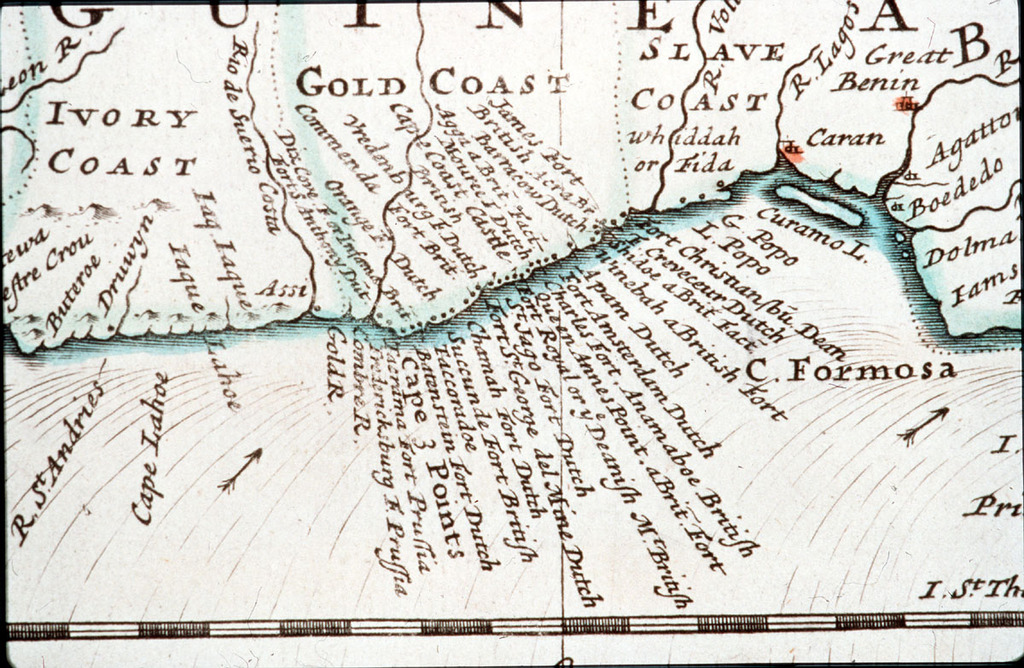
Ivory Coast, G Gold Coast, Slave Coast - Old map of the Slave Traders, including fortifications.
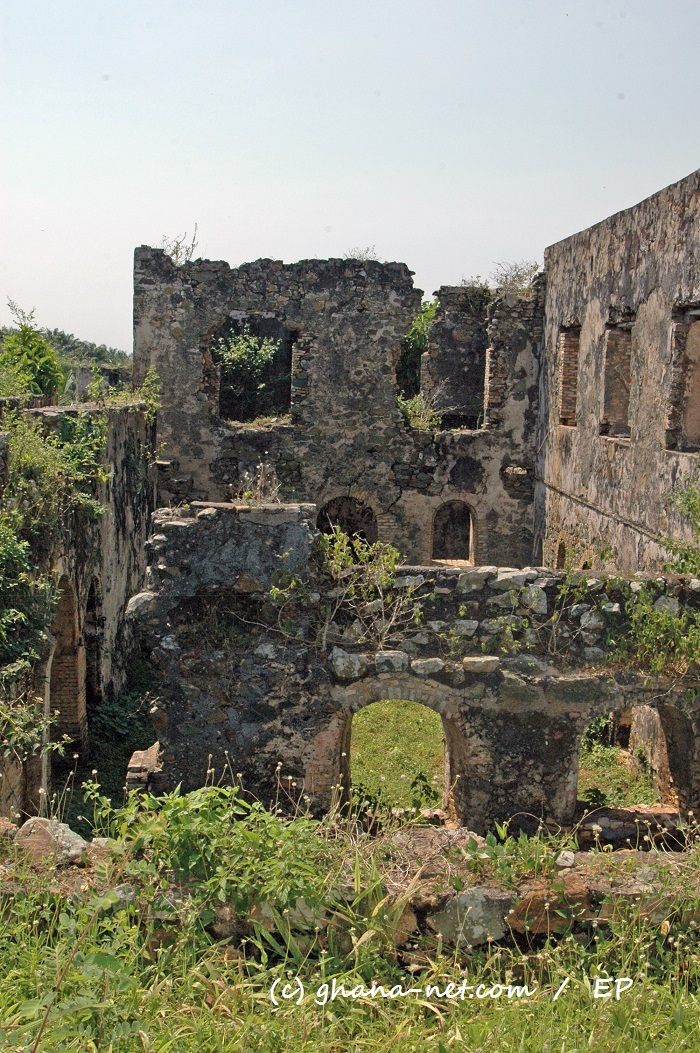
(c) Remo Kurka photography Fort Batenstein (Butre, Western region)